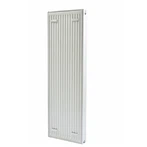
The core advantages of aluminum alloy radiators are high thermal conductivity, light weight and corrosion resistance, but they are susceptible to alkaline corrosion and difficult to process.
Main Advantages
- High thermal conductivity
The thermal conductivity of aluminum is three times that of steel, and adding a fan on the surface can further improve the heat dissipation effect. For example, plug-in aluminum alloy radiators are often used for relay heat dissipation.
- Lightweight and flexible in design
Lightweight and small in size, it saves at least 20% of space compared to steel radiators under the same heat dissipation requirements, reducing installation costs.
Supports free splicing and size adjustment, for example, the number of pieces can be increased or decreased on site to adapt to different scenarios.
- Corrosion resistance and long life
The life of anodized radiators can reach more than 15 years and is suitable for ordinary water quality (non-alkaline).
Aluminum itself is not easy to rust, and daily maintenance only requires water to clean the surface dust.
- Aesthetics and environmental protection
Surface treatment processes (such as sandblasting and brushing) enhance the appearance texture;
45-degree convection plate design reduces the problem of wall blackening.
Significant disadvantages
- Poor alkali resistance
It is susceptible to corrosion in alkaline water or old boiler systems, and requires full water maintenance or spraying of anti-corrosion paint, and cannot be mixed with radiators of other materials to avoid electrochemical corrosion.
- High processing difficulty
Cutting is prone to burrs, and professional equipment (such as aluminum cutting machines) are required to ensure process accuracy, otherwise it will affect the heat dissipation performance.
- Cost and applicability limitations
The cost of copper-aluminum composite radiators is higher than that of steel, and a trade-off is required when the budget is insufficient;
In high-load scenarios (such as key electronic components), copper radiators are still the first choice.
Application suggestions
Heating system: Suitable for residential areas with neutral water quality and flexible adjustment, copper-aluminum composite types are recommended;
Industrial field: Anodized aluminum profile radiators are preferred to extend service life.